
There seems to be something hard-wired in all of us that we look after what we own.
Opinion
Common tragedy
By
on 17 July 2019
Our primary instinct for ‘self-preservation’ probably means we nurture ourselves as the first ‘object’ we ‘own’ before moving onto those we buy. Of course, this idea of ownership can extend beyond into those things we create, even in the sense that we nurture and protect our family.
Even so, the darker side of this equation is that we can ignore or even damage people and things we have no ‘ownership’ relationship with, that are part of the ‘commons’.
We see this with the environment, in everything from protecting the climate, transboundary rivers and fish stocks, to public goods such as private roads. And public toilets!
Toilets? Yes, a recent report from public health experts warns a lack of public toilets is affecting the health of workers and the public at large. The Royal Society for Public Health report published in May found that 74 per cent of adults believe that there are not enough public toilets in their area.
It highlights outdoor workers among those ‘disproportionately’ affected, including bus drivers, street cleaners, lorry, delivery and taxi drivers, and refuse collectors.
As well as the inconvenience, there are health implications which, without going into details, includes workers reducing their liquid intake, not to speak of ‘holding on’ and the serious concerns of pregnancy and ‘period dignity’.
There is another element to this idea of the commons that can be easily missed, but which expressions like ‘common sense’ and ‘common decency’ point us toward. This is the idea of a shared humanity that we can easily ignore or define wrongly.
In the context of the workplace, with its prevailing ethos of success and individual reward, what is common – whether it’s the place we share or a shared requirement for safety, health or wellbeing – can be seen as pedestrian, humdrum or simply counter to entrepreneurship or merit.
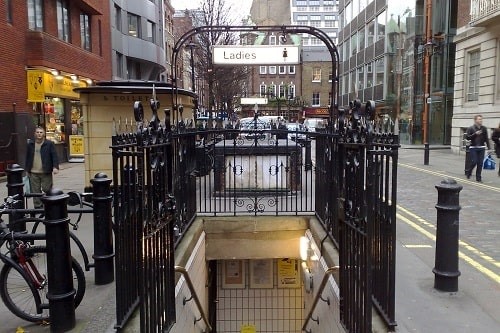 A recent report from public health experts warns a lack of public toilets is affecting the health of workers and the public at large.Photograph: Flickr / public toilet in Broadwick Street, London
There is an interesting tension in safety, health and wellbeing: though we all share an instinct for self-preservation – and responsibility to act in our own interest – the management of risks that originate with work are the responsibility of someone else. Who really owns our wellbeing?
As the tragedy of the commons tells us time and again, this tension is at the heart of why accidents happen or people are made sick and why, in our effort to improve things, we can get it so wrong. The danger of the wellbeing debate is that it constantly attempts to turn our common humanity into a series of measurable outputs that can be owned, nurtured and managed, but with the risk that such indicators are just used to say look, we have a high wellbeing score.
In fact – as with anything that sits in a spreadsheet but not in people’s minds – we can see that some organisations with the most boxes ticked are the most miserable to work in. And it matters, of course: we have said many times that poor wellbeing leads to poor performance and can destroy jobs for countless workers.
In recent days, there have been high-profile cases: bullying and sexual harassment in Lloyd’s of London; accusations of a toxic work culture, characterised by secrecy and mistrust, in Amnesty International; and the forced resignation of Ted Baker’s boss for ‘forced hugging’ and inappropriate comments and behaviour.
In the case of Amnesty, two cases of suicide linked to stress, overwork and a lack of attention to staff mental health; in the case of fashion retailer Ted Baker, a 25 per cent drop in share price. I don’t know if these organisations have wellbeing programmes, but I do know that too often organisations that say they are doing the right thing are often doing what’s required to look like they are. In reality, sometimes staff are treated as disposable objects and senior staff spend more time trying to look good rather than doing good.
The solution? A little bit of common sense. We know when something isn’t right. People are the best measure of a workplace. Let’s listen to them, and the British Safety Council will listen more to its members. That way we can all look after the commons.
Mike Robinson FCA
Chief executive
British Safety Council


OPINION

Migraine in work: a test of the Government’s plans to Keep Britain Working
By Rob Music, The Migraine Trust on 07 September 2026
Migraine can have a profound, and often avoidable, impact on people’s working lives and careers. The Government’s growing focus on workplace health offers an important opportunity to change this, but only if this common, often disabling and frequently invisible neurological condition is properly understood and addressed by Government, the NHS and employers.

Noise risk and multi-track enforcement: what EHS managers need to know
By Emma Tattersdill, Bexley Beaumont law firm on 17 August 2026
Noise nuisance from an industrial or commercial site can result in costly and time-consuming legal action from regulators and neighbours, but there are practical ways of ensuring noise levels do not exceed acceptable limits and trigger complaints from nearby businesses and residents.
A summer of seeing things differently
By Mike Robinson FCA, British Safety Council CEO on 07 August 2026
Some of the most serious risks to our health at work remain hidden, with the harmful consequences only becoming apparent years after exposure. The British Safety Council's new Hidden Hazards campaign seeks to raise awareness of these invisible risks that affect millions of workers, and encourage more concerted action by employers, the Government and others to prevent harm before it occurs.