

An eight-year investigation into an explosion at a Pembrokeshire oil refinery that killed four workers has culminated at court in a £5m fine for Valero Energy.
News
Valero Energy fined £5m after refinery explosion kills four
By
on 01 July 2019
Dennis Riley, 52, Robert Broome, 48, Andrew Jenkins, 33, and Julie Jones, 54 died after a storage tank exploded at the site in 2011. A fifth worker, Andrew Philips, also sustained major injuries.
Swansea Crown Court heard how on 2 June 2011, the five workers were emptying a tank in the Amine Recovery Unit using a vacuum tanker when the incident took place shortly after 6pm. B&A Contracts Ltd, a long-term contractor at the refinery, was carrying out the work, with support from another contractor, Hertel.
A fireball resulting from the explosion severed a five-tonne tank roof, which shot 55 metres out, hitting a butane storage sphere. The roof narrowly missed a pipe track where flammable materials were carried.
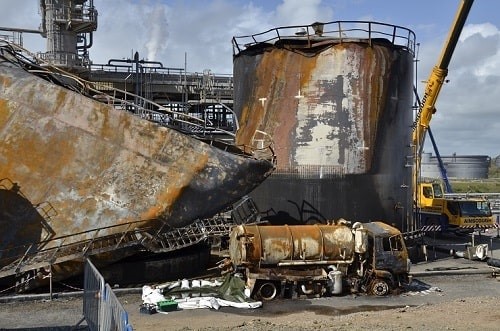 The Pembrokeshire oil refinery operated by Valero Energy after the blast occurred in 2011. Photograph: HSE
Ignition of a highly flammable atmosphere within the tank, during what should have been a routine emptying operation in preparation for further cleaning and maintenance, was the likely cause of the explosion, said HSE.
Its investigation also found ‘long-standing failures’ within the refinery safety management systems. As a result, the risks posed by flammable atmospheres inside the Amine Recovery Unit were not understood or controlled.
Valero Energy UK Ltd of Wood Street, London, which bought the refinery off Chevron Limited, was fined and ordered to pay costs of £1 million for breaches of sections 2(1) and 3(1) of the Health and Safety at Work Act 1974.
B&A Contracts Ltd of Hubberston Road, Pembrokeshire was also fined £120,000 and ordered to pay costs of £40,000.
Speaking after the final hearing on 6 June, investigating HSE inspector Andrew Knowles said: “This incident, which had devastating consequences for all of those involved, was entirely preventable. Many opportunities to take action to control risk were missed, that would have prevented the incident from occurring.
He added: "It is important to realise that the incident could have had even more serious consequences had the butane sphere or pipe track been damaged by the flying tank roof."
Detective Superintendent Anthony Griffiths said: “Officers from Dyfed-Powys Police worked closely with the Health and Safety Executive to support them in the very complex investigation to establish the cause of this tragic incident. We hope that the lessons learned ensure that a tragedy of this nature doesn’t happen again. Our thoughts remain with all the families involved.”


NEWS

Scheme to recognise commitment to transport staff wellbeing launched by Road Haulage Association
By Orchie Bandyopadhyay on 01 October 2026
A new Wellbeing Recognition Scheme designed to allow organisations across the HGV, coach and van sectors to demonstrate their commitment to improving the health, wellbeing and resilience of the industry’s workforce has been launched by the Road Haulage Association (RHA).

Cost-of-living pressure is cutting into UK workers’ productivity, says report
By Orchie Bandyopadhyay on 04 October 2026
The cost of living is the single largest financial stressor for 62% of UK workers, far outweighing concerns about retirement savings (12%) and building emergency funds (8%), a new study has revealed. Sixty-two per cent of workers admit they do not fully understand the workplace retirement plan they pay into each month, according to TELUS Health’s Q2 2026 TELUS Mental Health Index.

Employers must meet staff to discuss flexible working requests, says first secretary of state
By Orchie Bandyopadhyay on 01 October 2026
Bosses must meet with employees who request flexible working and explain their reasons for any refusals, said Louise Haigh, first secretary of state, in a speech to the Trades Union Congress (TUC) in Brighton on 15 September.