

Three quarters of teachers are being expected to clean their own classrooms and equipment, amid concerns some schools are not implementing effective measures to control the spread of coronavirus, a survey by teachers’ union NASUWT has revealed.
News
Teachers say ‘not yet safe’ for more pupils to return to school
By
on 06 July 2020
Secondary pupils in England, due to take exams next year, returned to school on 15 June, following some primary school year groups who have been permitted to return to school.
The survey, which heard from 20,617 teachers across England, found that as more schools reopen to pupils, teachers still have significant concerns over their own safety and access to personal protective equipment (PPE).
Asked whether they had access to PPE items, more than a quarter (27 per cent) did not have access to protective aprons and 24 per cent did not have access to masks and face coverings.
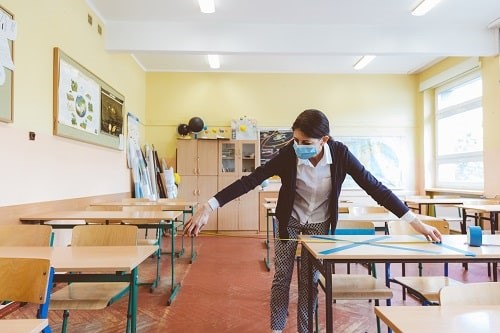 Safe social distancing and access to PPE continue to be major concerns for teachers. Photograph: iStock/izusek
BAME teachers were more likely to state that they did not have access to equipment including protective aprons (33 per cent); masks and face covering (34 per cent).
Most (74 per cent) said they had to clean down their own classrooms and equipment on a regular basis and more than a third (36 per cent) did not see cleaning staff throughout the day.
NASUWT general secretary Dr Patrick Roach said teachers are dedicated to their jobs and pupils, but seven in ten (72 per cent) say it is not safe for more pupils to return to their school: “The overwhelming majority of them feel it is not yet safe to open schools to more children while safe social distancing and access to PPE continue to be major concerns.
“In the absence of government guidance schools have been left to take measures to meet health and safety standards, but as our members have told us there is an inconsistent use of those measures to prevent coronavirus spread and reduce risks to staff and pupils,” he added.
He said cleaning is vital to prevent the spread of infection, but should be carried out by trained cleaning staff using appropriate materials. “Schools must ensure cleaning staff are available throughout the school day to carry out regular cleaning. This must not be left to teachers to do.”
Government ditched its goal to get more pupils back before the summer holidays. Boris Johnson said the coronavirus infection was “not yet quite low enough” to do so.
But Labour leader Sir Keir Starmer accused the government of failing to consult with stakeholders or to provide a “robust, national plan” to make returning to school possible. Speaking at the House of Commons, he said: “Current arrangements lie in tatters. Millions of children will miss six months of schooling and inequality will now go up.”


NEWS

Scheme to recognise commitment to transport staff wellbeing launched by Road Haulage Association
By Orchie Bandyopadhyay on 01 October 2026
A new Wellbeing Recognition Scheme designed to allow organisations across the HGV, coach and van sectors to demonstrate their commitment to improving the health, wellbeing and resilience of the industry’s workforce has been launched by the Road Haulage Association (RHA).

Cost-of-living pressure is cutting into UK workers’ productivity, says report
By Orchie Bandyopadhyay on 04 October 2026
The cost of living is the single largest financial stressor for 62% of UK workers, far outweighing concerns about retirement savings (12%) and building emergency funds (8%), a new study has revealed. Sixty-two per cent of workers admit they do not fully understand the workplace retirement plan they pay into each month, according to TELUS Health’s Q2 2026 TELUS Mental Health Index.

Employers must meet staff to discuss flexible working requests, says first secretary of state
By Orchie Bandyopadhyay on 01 October 2026
Bosses must meet with employees who request flexible working and explain their reasons for any refusals, said Louise Haigh, first secretary of state, in a speech to the Trades Union Congress (TUC) in Brighton on 15 September.