

One in 17 people in the UK have low life satisfaction and almost a quarter have high levels of anxiety, a new report focused on wellbeing by the Office for National Statistics (ONS) has revealed.
News
UK population becoming more anxious and less satisfied, ONS wellbeing report shows
By
on 09 May 2024
In its Measuring Progress, Wellbeing and Beyond GDP in the UK report, published on 9 May, the ONS said that the percentage of people reporting low satisfaction with their lives had increased to 5.8 per cent in the October to December 2023 quarter – up from 4.4 per cent in the same period five years ago.
 The ONS report revealed that one in 17 people in the UK have low life satisfaction. Photograph: iStock/Yuuka Hurunaga
The report also found that 23.5 per cent of respondents to the ONS’ Annual Population Survey said they felt high levels of anxiety in the final quarter of last year. While this was down from 25.2 per cent in the last three months of 2020, during the pandemic, it was up on the 20 per cent figure from the same period in 2018.
Fewer people are spending enough time outside to gain the health benefits of being in nature, said the ONS, and the average amount of time spent on entertainment, socialising and free-time activities has fallen. Meanwhile, financial pressure associated with high interest rates was cited as having the third biggest impact on people’s wellbeing, after the welfare of family members and personal physical or mental health issues.
The latest report, which the ONS said “aims to give an holistic view on how society is doing, beyond purely economic measures” follows figures released last month by the government department, which revealed that the number of working-age people in the UK who are neither employed nor looking for a job had risen again in the three months to February 2024. This was primarily driven by a record number of people who are economically inactive due to long-term sickness.
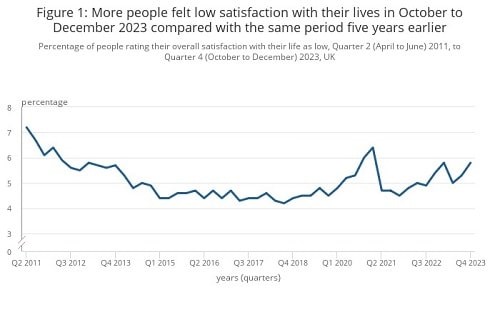 Source: Annual Population Survey from the Office for National Statistics.
Outlining its reasons for publishing a report that focuses more on wellbeing, the ONS said: “Measures of a country’s progress have often tended to focus on economic growth, usually measured by gross domestic product (GDP). However, GDP omits important elements affecting the wellbeing of society and the environment, and the way these impacts are distributed.
“So, to complement traditional economic statistics, we have been developing new, and improving existing, measures of national progress, prosperity and wellbeing.”
British Safety Council chief executive Mike Robinson has welcomed the new report, describing it as “a positive innovation, placing focus on wellbeing as a measure of national success”.
“However,” he added, “the report’s findings paint a bleak picture, with increases in economic inactivity and low life satisfaction, driven in part by the wider economic context. We know that financial pressures, alongside other causes of stress, are contributors to poor wellbeing.
“That’s why British Safety Council has called on any future government, in our Health, Safety and Wellbeing Manifesto, to appoint a dedicated Minister for Wellbeing, who would lead a National Wellbeing Strategy. This would, for the first time, create a joined-up, holistic approach to wellbeing.”


NEWS

Scheme to recognise commitment to transport staff wellbeing launched by Road Haulage Association
By Orchie Bandyopadhyay on 01 October 2026
A new Wellbeing Recognition Scheme designed to allow organisations across the HGV, coach and van sectors to demonstrate their commitment to improving the health, wellbeing and resilience of the industry’s workforce has been launched by the Road Haulage Association (RHA).

Cost-of-living pressure is cutting into UK workers’ productivity, says report
By Orchie Bandyopadhyay on 04 October 2026
The cost of living is the single largest financial stressor for 62% of UK workers, far outweighing concerns about retirement savings (12%) and building emergency funds (8%), a new study has revealed. Sixty-two per cent of workers admit they do not fully understand the workplace retirement plan they pay into each month, according to TELUS Health’s Q2 2026 TELUS Mental Health Index.

Employers must meet staff to discuss flexible working requests, says first secretary of state
By Orchie Bandyopadhyay on 01 October 2026
Bosses must meet with employees who request flexible working and explain their reasons for any refusals, said Louise Haigh, first secretary of state, in a speech to the Trades Union Congress (TUC) in Brighton on 15 September.